What bulb wattage works best for a bedside reading lamp?
The ideal bulb for bedside reading is a 4 to 6 watt LED producing 400 to 450 lumens at 2700K. Here is how to pick the right brightness without straining your eyes.
In this article
- Key takeaways
- Why should you stop shopping by wattage alone?
- How many lumens do you actually need for bedside reading?
- What color temperature keeps your room restful?
- How does lampshade design affect your bulb choice?
- Where should the lamp sit on your nightstand?
- What about smart bulbs and dimmers?
- Common mistakes to avoid
The best bulb for a bedside reading lamp is a 4 to 6 watt LED, which generates roughly 400 to 450 lumens. This gives you enough contrast to read printed pages comfortably without flooding a small bedroom with blinding glare. If you use an older incandescent bulb, the direct equivalent is 40 watts.
Key takeaways
- Aim for 400 to 450 lumens (4 to 6 watts in modern LED bulbs).
- Stick to a warm white color temperature of 2700K to protect your wind-down routine.
- Avoid 800-lumen bulbs (60-watt equivalents) because they cause harsh page glare at close range.
- Keep the bottom rim of your lampshade at eye level when sitting propped up in bed.
Why should you stop shopping by wattage alone?
Wattage measures power consumption, not brightness. Old incandescent bulbs used wattage as a rough brightness gauge because they all burned energy at the same rate. Modern LEDs use up to 85 percent less electricity to produce the exact same amount of light, which makes traditional wattage numbers useless on new packaging.
When buying a bulb today, look at lumens instead. Lumens measure actual visible light output. A traditional 40 watt incandescent bulb puts out about 450 lumens. An LED bulb hits that same 450-lumen mark while pulling only 5 watts from the wall.
If you grab a 9 watt or 10 watt LED assuming it is dim, you are actually buying an 800-lumen powerhouse designed to light up an entire corner of a room, not a book page 20 inches from your pillow.
| Bulb Technology | Bedside Reading Target | Overly Bright for Bedside |
|---|---|---|
| Modern LED | 4 to 6 Watts (400 to 450 Lumens) | 9 to 12 Watts (800+ Lumens) |
| Incandescent | 40 Watts (450 Lumens) | 60 Watts (800 Lumens) |
| Halogen | 28 Watts (450 Lumens) | 42 Watts (800 Lumens) |
How many lumens do you actually need for bedside reading?
For comfortable bedside reading, 400 to 450 lumens is ideal. This level supplies clean contrast across paper or an unlit e-reader without reflecting blinding white spots back into your eyes.
If you are over 50 years old, your eyes naturally let in less ambient light, meaning you might need closer to 500 to 600 lumens to read fine print effortlessly. However, jumping straight to an 800-lumen bulb often backfires. At close proximity, 800 lumens turns crisp paper into a mirror, causing eye fatigue within twenty minutes.
The one genuine drawback of dropping to 400 lumens is utility. A 400-lumen bedside lamp will not illuminate the rest of your bedroom. It is strictly a task-and-mood light. If your nightstand lamp is the only light fixture in your entire studio flat, a single 400-lumen bulb will leave the far corners dim.
What color temperature keeps your room restful?
Color temperature matters just as much as brightness, and the golden rule for bedrooms is 2700K. Light color is measured on the Kelvin scale, ranging from amber glow up to blue daylight.
A 2700K bulb produces warm white light. It has a slight yellow-orange character that feels natural next to wood tones, textiles, and painted drywall. More importantly, warm light contains significantly less blue spectrum light. Blue light suppresses melatonin production, which makes falling asleep after reading much harder.
Avoid bulbs marked "Daylight" (5000K) or "Cool White" (4000K) on your nightstand. While crisp white light works wonders over a kitchen cutting board or a garage workbench, next to a pillow it feels institutional and visually harsh. If you want a slightly cozier, hotel-like glow, look for 2400K, though anything lower than 2200K becomes too orange for reading dark typography clearly.
How does lampshade design affect your bulb choice?
A bare bulb at 450 lumens will hurt your eyes, but the exact same bulb inside a dense fabric shade can feel cozy and gentle. The shade material determines how that light travels.
If your bedside lamp uses a translucent drum shade made of white linen or frosted glass, light spreads omnidirectionally. A standard 450-lumen bulb works perfectly here. If your lamp has an opaque metal dome, such as an angled task or pharmacy lamp, all 400 lumens are focused into a tight, direct beam downward. In an opaque directional shade, even a 450-lumen bulb can feel intense. If you use a directional task lamp, consider dropping down to 250 or 300 lumens (around a 3 watt LED).
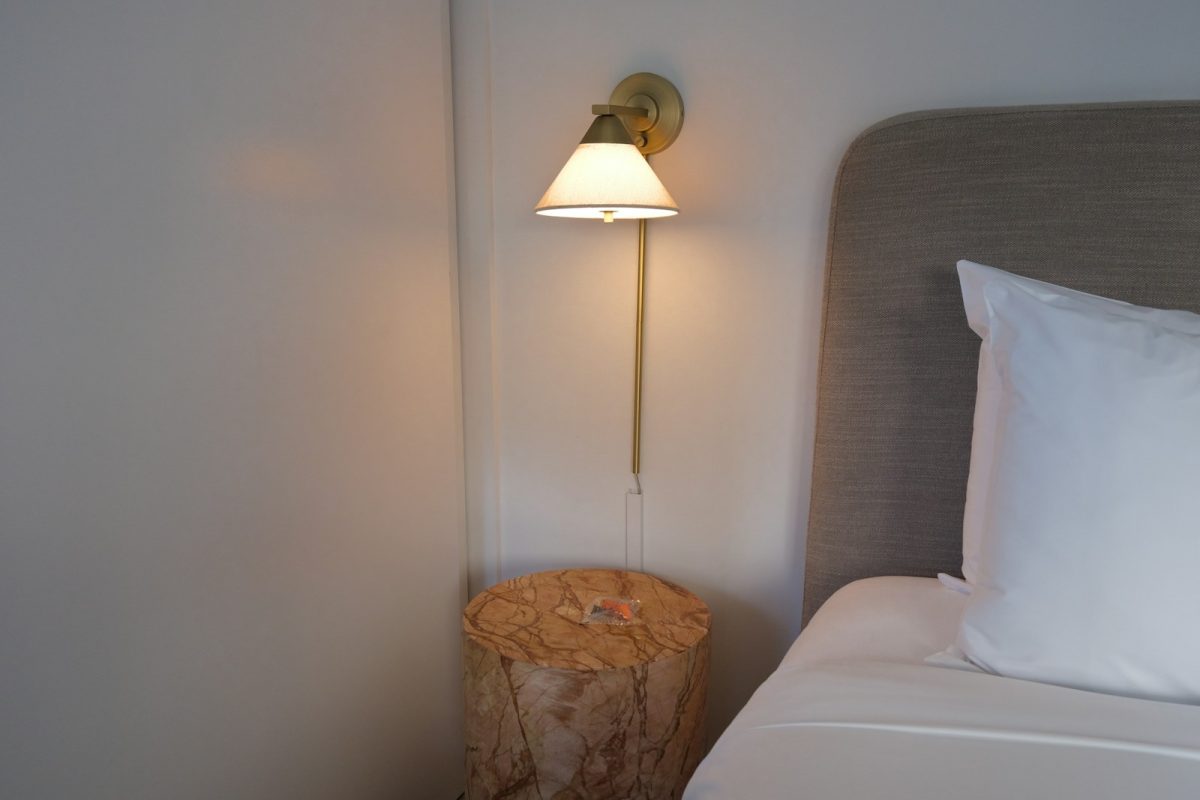
For clip-on headboard lights or swing-arm wall sconces, pick a bulb with a frosted shell rather than clear glass. Clear glass bulbs cast sharp filament shadows and produce pinpoint glare spots that tire your retinas while you read.
Where should the lamp sit on your nightstand?
Bulb wattage means nothing if the lamp is at the wrong height. The most common mistake in flat bedrooms is using a lamp that sits either far too low or far too tall relative to the mattress.
When you sit propped up in bed with your reading material, the bottom edge of your lampshade should align roughly with your eye level. This positioning keeps the bare bulb hidden from direct view while allowing the cone of downward light to illuminate your lap or hands.
If your nightstand is short, look for a taller lamp base so the shade does not dump light against your ribcage. If you rent a compact space and your bedside table is crowded, wall-mounted plug-in sconces save valuable surface area. You can find solid plug-in wall fixtures and compact lamps at lifestyle shops like MaviGadget to keep bedside tables uncluttered.
What about smart bulbs and dimmers?
If you cannot decide on a fixed wattage, a dimmable LED solves the problem instantly. Many basic LED bulbs hum or buzz when connected to standard wall dimmers, so make sure the bulb packaging explicitly states "dimmable."
A smart LED bulb running on Wi-Fi or Bluetooth gives you adjustable brightness from 1 percent up to 100 percent. You can set it to 100 percent (roughly 800 lumens) while folding laundry or making the bed, and dial it down to 40 percent (around 320 to 400 lumens) when you open your book.
The catch with smart bulbs is standby power and connectivity drops. If you flip the physical lamp cord switch off, the bulb loses power and disconnects from your phone or voice assistant. If you want zero fuss, buy a quality, fixed 5 watt, 2700K warm white LED bulb and let it do one job well.
Common mistakes to avoid
- Buying "daylight" bulbs thinking they make reading easier. They cause eye strain at night and disrupt sleep schedules.
- Using a clear filament Edison bulb at eye level without a shade. The exposed glowing wire burns bright afterimages into your vision.
- Placing the lamp behind your head. Overhead backlighting casts your own head and shoulders as a shadow directly across the page.
- Oversizing the lumen output. Anything over 500 lumens in an open shade will bounce harsh light off your bedroom walls and defeat the restful mood you want before sleeping.

